
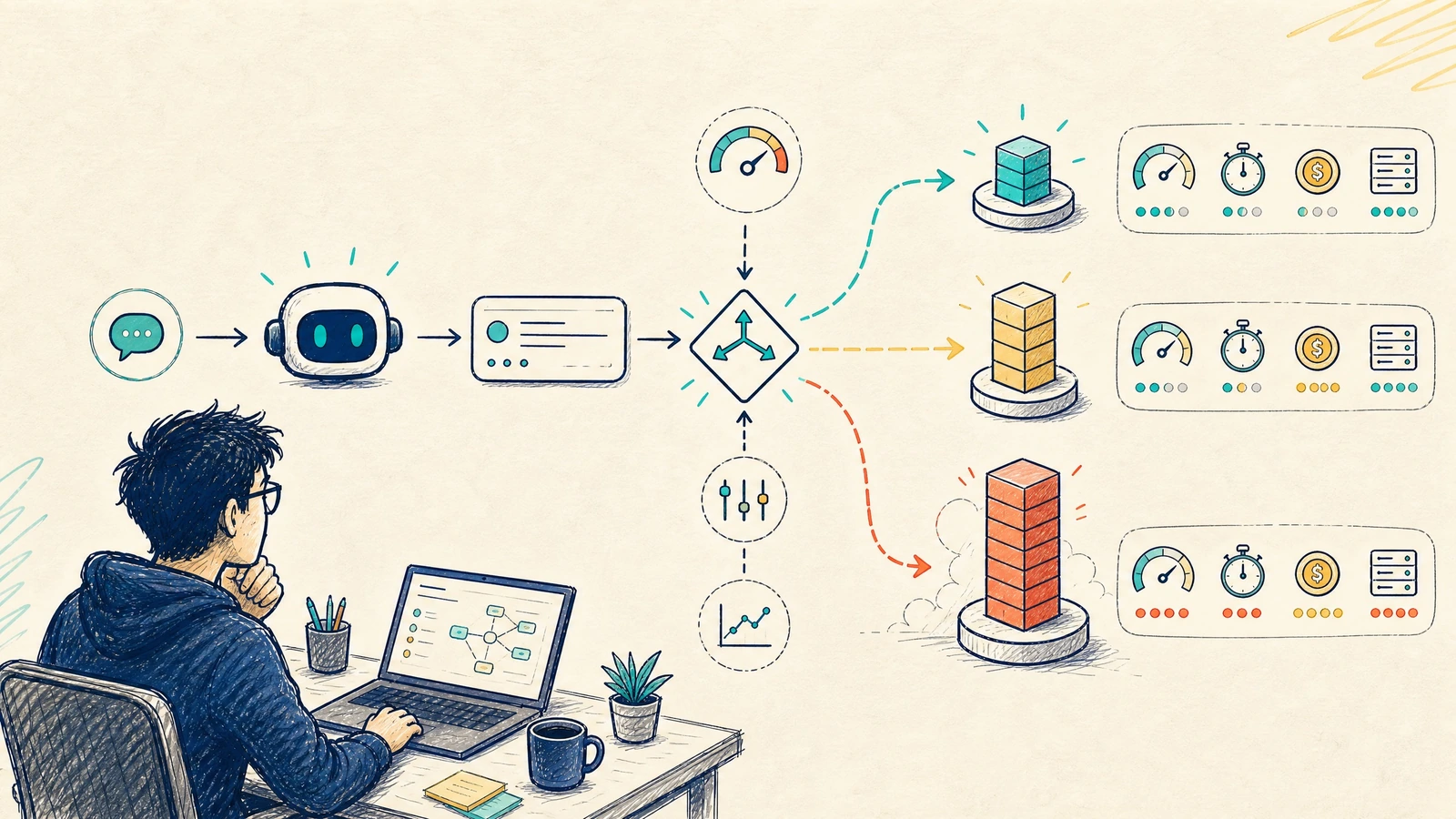
I used to think model selection was a configuration decision. Pick a model, put its name in an environment variable, and move on to the interesting part: tools, retrieval, orchestration, and user experience.
That mental model stops working as soon as an agent becomes useful. One turn may need a cheap classifier. The next may need careful reasoning over a long context. A later step may be mostly mechanical tool-call formatting. Sending every step to the most capable model wastes money and adds latency. Sending everything to the smallest model produces a system that is fast right up until a difficult case quietly becomes a bad decision.
The practical problem is not “which model is best?” It is which model is good enough for this step, under this context, at this moment, within this budget and failure policy?
This article describes a model router as a production component rather than a clever prompt. It covers routing signals, a multi-stage decision policy, fallback behavior, shadow traffic, observability, and the design mistakes that make a router impossible to trust. The goal is not to claim that routing always reduces cost or improves quality. The goal is to make the trade-off explicit, measurable, and reversible.
The thesis: A model router should optimize for a constrained outcome, not for a model leaderboard. It must know when a task is routine, when uncertainty is increasing, when the provider is unhealthy, and when the cheapest route has become more expensive than escalation.
The router is an admission-control layer for reasoning
An AI agent has more than one kind of work. It classifies an intent, plans a sequence, extracts fields, calls a tool, interprets a tool result, writes a user-facing explanation, and sometimes recovers from an error. Those steps have different capability requirements.
A useful router sits between the agent runtime and the model gateway. The runtime asks for a completion with a task type, context, tool schema, policy, and budget. The router returns a model target plus a decision record. The runtime does not need to know whether that target is a hosted frontier model, a regional endpoint, a self-hosted small model, or a temporary fallback.
This separation matters because model identifiers change more often than the agent’s business contract. It also creates a place to enforce policy: a sensitive tenant may require a region, a long-running workflow may require session affinity, and a low-value classification step may have a hard cost ceiling.
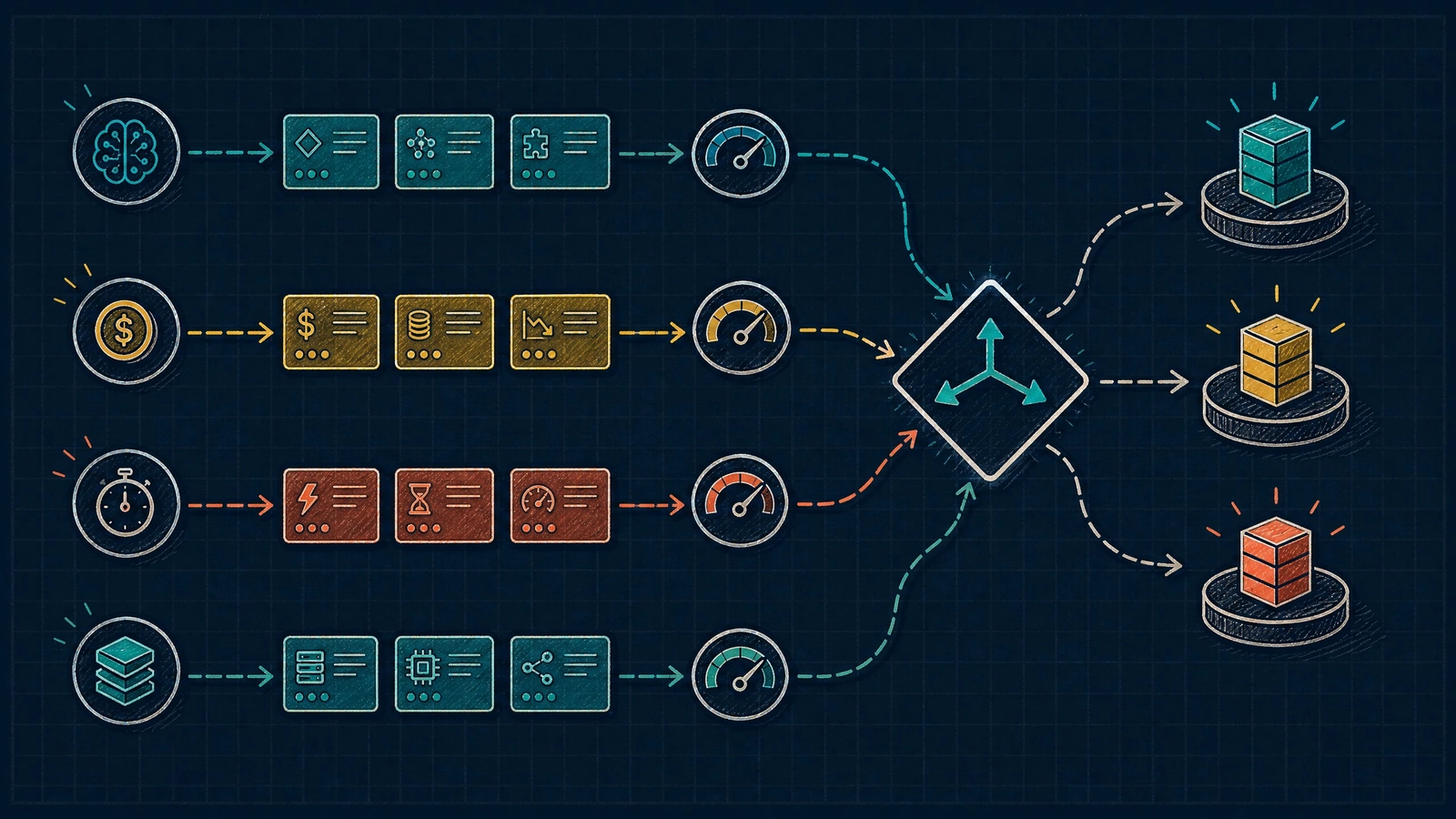
A router should therefore be treated like admission control in a distributed system. It decides whether a request can enter a model pool, which pool is appropriate, and what happens when the preferred pool is saturated. This is different from simply retrying a failed HTTP request. A retry says, “try the same dependency again.” A router says, “reconsider which dependency is appropriate.”
Three signals are necessary, but not sufficient
NVIDIA’s description of production model routing groups the most important signals into model capability, model cost profile, and infrastructure state. That is a useful starting point, but an agent platform usually needs a fourth dimension: authority and data policy.
| Signal | What the router needs to know | Example decision |
|---|---|---|
| Capability | Which model is likely to solve this task correctly? | Use a stronger reasoning model after repeated tool errors. |
| Cost | What is the marginal price of this route, including long outputs and tool calls? | Keep routine extraction on a small model. |
| Latency | What response time can this step tolerate? | Prefer a warm regional endpoint for interactive turns. |
| Infrastructure | Is the model healthy, loaded, rate-limited, or timing out? | Avoid a pool with rising queue time. |
| Policy | Can this context be sent to this provider or region? | Route restricted tenant data to an approved endpoint. |
| Session state | Should later turns remain on the same model or route family? | Preserve affinity when a task depends on a model-specific working state. |
The router should not pretend these values are exact. Capability is an estimate, not a property that can be read from a model card. Cost depends on input length, output length, caching, retries, and tool-call loops. Latency includes queue time, time to first token, streaming duration, and the time the agent spends interpreting the result.
A practical decision record makes the uncertainty visible:
{
  "route_id": "rt_01J9...",
  "task_kind": "tool_argument_generation",
  "candidate_pool": ["small-fast", "balanced", "frontier"],
  "selected": "balanced",
  "signals": {
    "estimated_difficulty": 0.61,
    "context_tokens": 18400,
    "queue_ms": 42,
    "remaining_budget_usd": 0.018,
    "policy_region": "approved-eu"
  },
  "reason": "medium difficulty; balanced pool meets p95 latency budget",
  "fallback": "small-fast"
}
Do not log raw prompts merely to make routing explainable. The route record can contain classifications, hashes, token counts, policy labels, and model outcomes without becoming a second data-exfiltration channel. This connects naturally to the privacy-aware observability practices already described in the agent observability article.
Start with a policy, not a machine-learning router
Teams often jump directly to a learned router. That can be useful later, but it makes the first production failure difficult to explain. Begin with a policy that a human can inspect.
A simple four-stage policy works surprisingly well:
- Filter candidates by policy. Remove models that cannot receive the tenant’s data, do not support the required tool format, or cannot satisfy the region and retention requirements.
- Estimate task difficulty. Use deterministic features, a small classifier, or the agent stage. A short extraction step and a recovery step should not enter the same bucket by accident.
- Filter by operational budget. Exclude candidates whose predicted queue time, cost, or remaining context window violates the request budget.
- Rank and monitor. Choose the highest expected utility, then preserve a fallback and an escalation rule.
The router can be represented as a constrained score rather than an opaque “best model” label:
def choose_model(request, candidates, state):
    allowed = [m for m in candidates if policy_allows(request, m)]
    viable = [m for m in allowed if (
        m.context_window >= request.context_tokens and
        predicted_latency(m, request, state) <= request.latency_budget_ms and
        predicted_cost(m, request) <= request.remaining_budget_usd
    )]

    if not viable:
        return emergency_route(request, allowed, state)

    return max(viable, key=lambda m: (
        expected_quality(m, request) -
        0.35 * normalized_cost(m, request) -
        0.25 * normalized_latency(m, request, state)
    ))
The numbers in this example are not universal defaults. They are a reminder that the weights belong to the product’s constraints. A customer-support reply may prefer latency. A legal extraction task may prefer quality. A batch enrichment pipeline may prefer cost and throughput. One global score is usually less honest than a small number of named route policies.
Route by agent stage, not only by user prompt
A prompt classifier sees the user’s words. An agent runtime sees more: the number of failed tool calls, the size of the working context, the type of next action, and whether the workflow is making progress.
A stage router can therefore choose a smaller model during routine work and escalate when the trajectory becomes difficult. For example, exploration may need stronger reasoning, while formatting a validated result can use a faster model. A tool error followed by another tool error is a stronger escalation signal than a complicated sentence in the user’s first message.
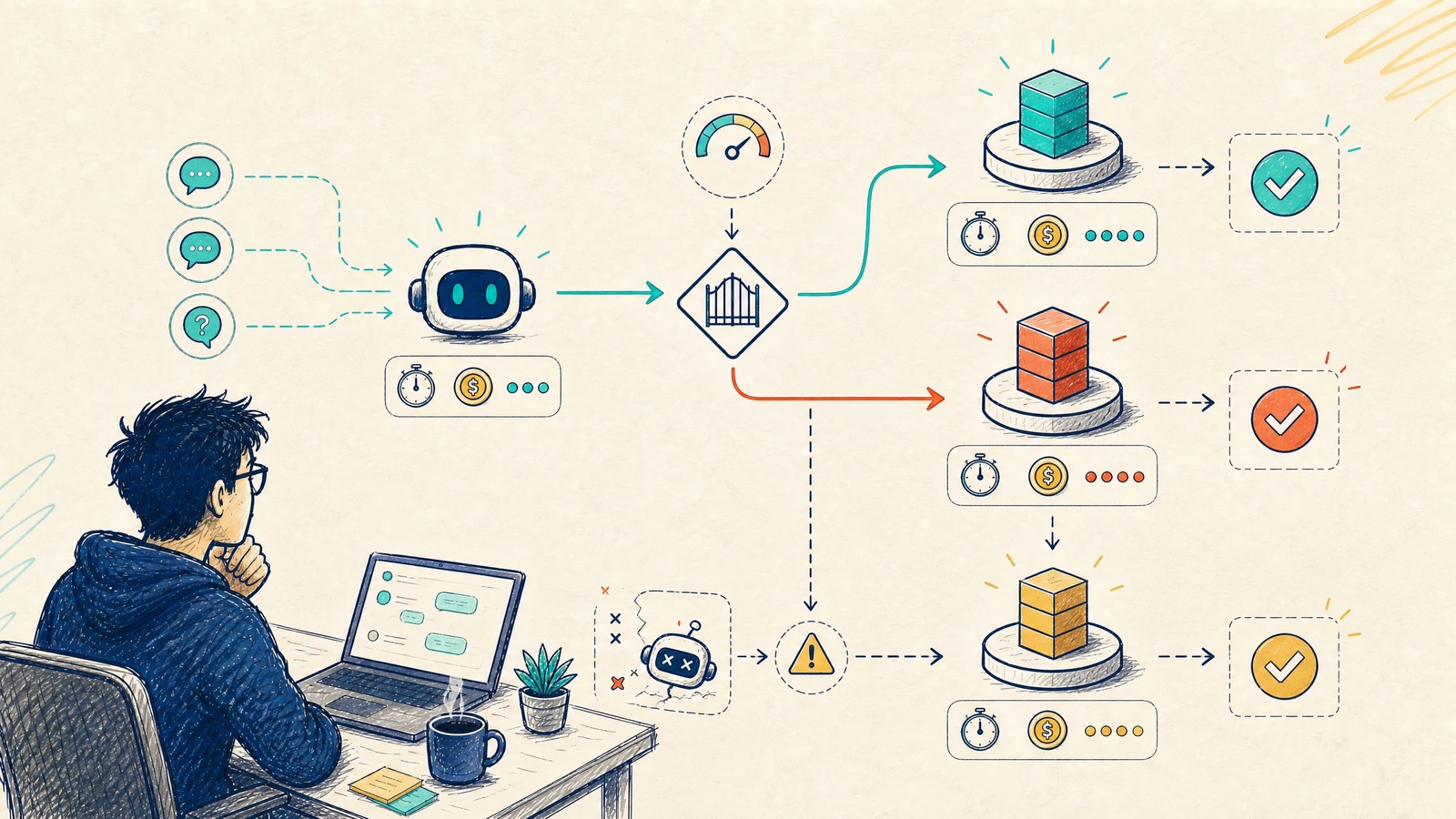
Useful escalation signals include:
| Signal | Why it matters | Safe reaction |
|---|---|---|
| Repeated invalid tool arguments | The current model is not aligning with the contract. | Escalate once, then stop if the contract remains broken. |
| No progress across turns | The agent is looping or exploring without reducing uncertainty. | Change model or return for human clarification. |
| High uncertainty or disagreement | The answer is not stable across candidate checks. | Run a stronger judge or require evidence. |
| Queue growth | A nominally cheap model has become slow under load. | Route to a healthy pool or shed work. |
| Provider errors | The dependency is failing, not merely producing a weak answer. | Open a circuit and use a policy-approved fallback. |
| Context overflow | The current route cannot safely see the task state. | Compact, retrieve selectively, or escalate to a larger window. |
Escalation should be bounded. If every failure moves to a larger model, a malformed tool schema can become an expensive retry storm. The router needs a maximum number of transitions, a total budget, and a final behavior such as “ask the user,” “queue for review,” or “return a safe partial result.”
Fallback is not a single retry
A provider fallback is useful, but it needs semantics. There are at least three distinct cases:
- Transport failure: the request never produced a usable response. A different provider may be safe to try.
- Quality failure: the model returned a response, but validation rejected it. A stronger route may help, but blindly replaying the same prompt can repeat the error.
- Policy failure: the route is not allowed for this tenant or data class. Retrying against another forbidden endpoint is not recovery.
The runtime should persist the route decision and the reason for every transition. When a response is streamed, the router should also define what happens after partial output. A user may already have seen tokens before the provider fails. The safe behavior may be to terminate the stream, display a retry boundary, or continue with a different route only if the product can clearly mark the transition.
Circuit breakers belong around provider pools, not around the entire agent. One unhealthy model should not take down unrelated tasks. Conversely, a fallback should not silently bypass a data residency or safety policy merely because the primary endpoint is unavailable.
Measure routes with counterfactual evidence
The first dashboard should answer operational questions, not celebrate a lower average cost.
Track route choice, model outcome, validation result, time to first token, total latency, input and output tokens, retry count, escalation count, provider errors, and the final business outcome. Break them down by task kind, tenant, region, workflow stage, and model pair. Averages hide exactly the cases that cause user-visible pain, so include p50, p95, and tail error rates.
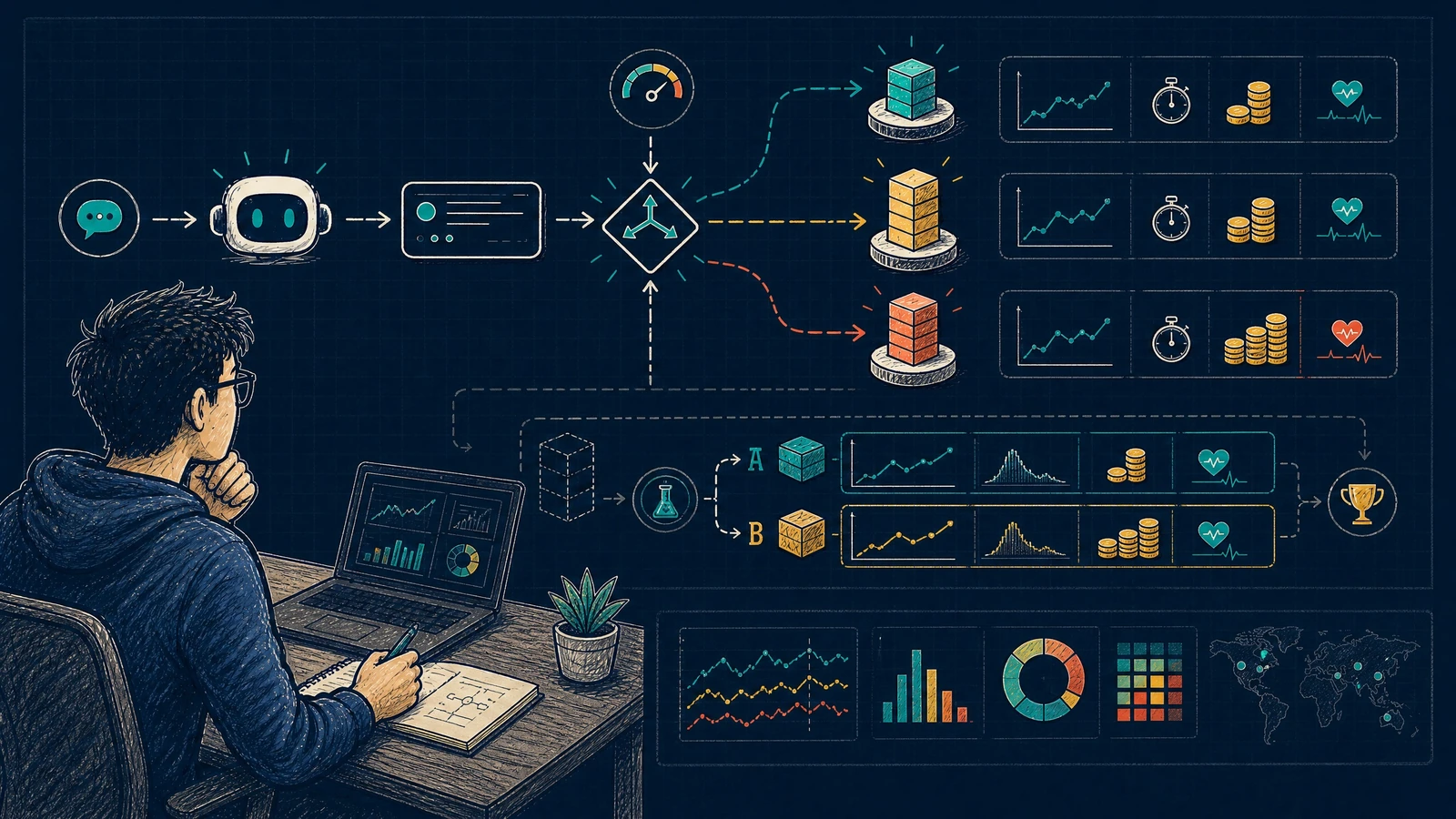
Shadow traffic is a useful bridge between intuition and production decisions. The primary model serves the user; a second candidate receives a privacy-safe or sampled copy and is evaluated without affecting the outcome. Shadow evaluation should be bounded by cost and must not accidentally execute tools or mutate state. It can compare structured outputs, rubric scores, latency, token use, and failure modes.
A simple rollout can proceed in four steps:
| Stage | Exposure | Exit condition |
|---|---|---|
| Offline replay | Historical or synthetic traces | Candidate route meets quality and policy gates. |
| Shadow | 1–5% sampled requests | No unacceptable data, cost, or latency regression. |
| Guarded canary | 5–10% of eligible traffic | Tail latency and tool-error rates stay within budget. |
| Default route | Remaining traffic | Automatic rollback remains available. |
Do not compare a new model only on answer preference. Compare the complete agent trajectory: did it call the right tool, preserve the state invariant, finish within the budget, and produce an outcome that a user can act on? That is the same distinction between a pleasant demo and a releasable agent described in the regression-suite article.
Where model routers fail
A router becomes dangerous when its abstraction hides important differences between models. Models may implement tool calling differently, interpret JSON schemas differently, support different context windows, or produce different verbosity profiles. A provider-neutral interface must normalize what can be normalized and expose what cannot.
Another failure is route flapping. If a model is selected independently at every turn, a multi-step task can bounce across providers, lose useful affinity, and become difficult to debug. Use a session route lease when continuity matters, but allow explicit escalation when the current route is no longer healthy or capable.
The third failure is optimizing cost locally while increasing total work. A cheap model that produces malformed arguments may cause several retries and a second model call. Measure cost per successful outcome, not only cost per request. The same principle applies to latency: a fast first token is not useful if the agent spends three extra turns repairing the answer.
Finally, never make the router the place where business policy is invented. The router may enforce that a tenant requires an approved region or that a task has a budget. It should not decide whether a refund is allowed, whether a person is eligible, or whether a state transition is legally valid. Those rules belong to explicit domain services and action gates.
A production checklist
Before turning on a model router, I would want clear answers to these questions:
| Question | Minimum evidence |
|---|---|
| Can we explain each route? | A decision record with candidate set, signals, policy, and reason. |
| Can we bound escalation? | Maximum transitions, retry budget, and terminal behavior. |
| Can we preserve sensitive-data rules? | Candidate filtering and tests for region, tenant, and data class. |
| Can we detect route degradation? | Per-route quality, latency, cost, provider errors, and outcome metrics. |
| Can we roll back? | A static policy or previous route version that can be restored quickly. |
| Can we evaluate without side effects? | Replay and shadow harnesses that cannot invoke write tools. |
A model router is not an excuse to stop improving prompts, tools, retrieval, or agent state. It is the layer that acknowledges a more uncomfortable truth: an AI system has multiple workloads inside it, and they should not all be priced, timed, and trusted in the same way.
The best router will sometimes choose the strongest model. It will also know when that choice is unnecessary, when it is too late, and when the correct action is to stop. That is what turns “multi-model” from a cost-saving slogan into an engineering discipline.
References
[1]: NVIDIA Technical Blog — Route AI Agent Workloads Across Models with NVIDIA NeMo Switchyard [2]: LangChain — State of AI Agents [3]: Do Quoc Viet — Agent observability without data leaks [4]: Do Quoc Viet — Regression evals for tool-calling agents
Comments (0)