

Hi! I’m Do Quoc Viet.
I’m currently a K20 student majoring in Data Science at the University of Science, Vietnam National University - Ho Chi Minh City (HCMUS).
Today I’m writing this post to share about the major, the school, and my first-year experience at HCMUS, so students from later cohorts who are considering it or who have just finished the university entrance exam can refer to it and choose what’s best for themselves.
1. Data Science
Data Science: “the sexiest job of the 21st century” — according to Harvard Business Review.
In recent years, big tech companies such as Grab, Momo, Tiki, Shopee, and banks have been constantly recruiting for Data Science positions with dizzying salaries.
Search volume for IT in general and Data Science in particular has surged. Although the major has only started recruiting at universities in recent years, the admission scores keep rising.
Now data, Big Data, and artificial intelligence are everywhere. The potential of this field will continue to grow strongly because, as society moves from Industry 4.0 toward 5.0, it will produce more and more data, which in turn creates more jobs to optimize that huge amount of data. Starting to learn now is the right choice to catch the trend in the next 3–4 years.
2. The Curriculum at HCMUS
| Information | Details |
|---|---|
| Program | Regular/Standard |
| Tuition | 13 million VND/year (2020) |
| Campuses | Thu Duc / District 5 |
| Degree | Bachelor |

The Data Science major at the University of Science, Vietnam National University - Ho Chi Minh City, belongs to the Faculty of Mathematics and Informatics (with combined support from the Faculty of Information Technology).
The first two years of the program are about 80% identical to the IT group curriculum. Mathematics courses are taught by the Faculty of Mathematics and Informatics, while programming and information technology courses are taught by the Faculty of Information Technology.
So it’s almost the same as the IT group curriculum. The real differences only appear when you enter the specialized courses in year 3.
However, since Data Science still belongs to the Faculty of Mathematics and Informatics, mathematics is emphasized heavily throughout the program and in the major itself. Especially for those who want to go deep into AI, you need to focus strongly on math. Mathematics is the backbone of Data Science. Statistics, regression models, basic 2D and 3D geometry, matrices, distribution models… are used every day in Data Science. If you’re good at math, you’ll be in control when entering this field.
How to choose a specialization? In Vietnam, Data Science has several main career directions:
- Data Analyst: Performs analysis on data and visualizes it to provide insights for business decisions. Example: You’re given business data and the company wants to increase revenue; you analyze and point out that removing X% of low-quality sales will increase revenue by Z%.
- Data Scientist: Handles data processing and builds predictive and descriptive models from it. DS is more research-oriented. This requires methods such as sophisticated analysis, machine learning, advanced statistics… The goal is to understand user behavior better and create predictive models. Example: researching Shopee product recommendation models, large language models like GPT-3.5.
- Data Engineer: Stronger on software engineering. They develop, build, and maintain data storage architectures (data warehouses), design data pipelines, especially at large scale (big data). They can collect and process raw data and improve reliability, efficiency, and quality. To do this, they need to use many languages and tools to connect systems, such as SQL, NoSQL, ETLs, Hadoop, Spark, Hive, Kafka…
- Machine Learning Engineer: Builds artificial intelligence models that can predict based on input data and produce expected output with high accuracy, stable speed, and applicability to real-life problems. Sometimes similar to DS but with more engineering aspects. Mainly two branches: natural language processing and computer vision. Examples: autonomous driving, intelligent traffic systems, virtual assistants, smart IP cameras, disease diagnosis…
Of course, each of us has our own dream. No matter the environment, self-learning and self-research are always most important. You can master any technology and become a Web Developer, Software Engineer, BA, Accountant… Don’t overfocus on what the university will teach you; it’s all about your own proactive learning. Nothing stops you from using a Data Science degree to pursue other careers in IT or Economics. Treat university as a stepping stone; every decision after that is in your hands.
3. What You Need to Know at HCMUS
What is a credit (TC)?
To make it simple, each course corresponds to a certain number of credits depending on teaching time, difficulty, and importance.
For example, each credit costs 265,000 VND (2021). So for Calculus 1B with 3 credits, the course costs 795,000 VND.
Thus tuition each semester is based on the total number of credits of the courses you take. If you fail a course, you have to pay the corresponding amount and retake it.
The total number of credits required to graduate is 132 TC (not counting PE and English). You can register for extra courses each semester or summer courses to graduate early. However, note that each semester you can take a maximum of 25 TC and 12 TC for the summer semester.
Conduct Points
The conduct point system is evaluated on a scale of 100. It resets every semester. To earn conduct points, you need to fully participate in classes, join faculty and university youth union activities, competitions, clubs…
- 90-100: Excellent
- 80-89: Good
- 65-79: Fair
- 50-64: Average
- 35-49: Weak
- 0-34: Poor
Try to keep conduct points at Fair or above every semester to avoid disciplinary action.
More information at HCMUS Conduct Point Regulations.
How to Calculate Graduation GPA
The formula is Sum([Course grade] * [Course credits]) / [Total credits]
Or you can use my ready-made spreadsheet GPA Calculator.
4. First-Year Review
English
First of all, English. At the start of the school year you’ll take a placement test and be assigned to English 1 or English 2. If you have an English certificate, you may not need to take the course.

Physical Education
There are options like soccer, volleyball, badminton, basketball… The class may be divided by majority vote, split, or you may not get your choice. It depends on the teacher.
General Education Courses
These include subjects such as Marxist-Leninist Philosophy, Marxist-Leninist Political Economy, General Law…
These are non-major courses. They contain interesting knowledge and concepts you may never have heard of. Passing is easy, but scoring 9–10 is rare. If you want to graduate with honors or get a scholarship, pay attention to these subjects too!
Programming
A classmate in Data Science once said: “I’d rather study math.”
The first semester starts with Introduction to Programming:
You’ll get familiar with concepts like variables, conditional statements, loops, subprograms… using C++. If you already have programming knowledge from high school, getting a 9.5–10 in this course isn’t hard.
Many people ask: “Why doesn’t Data Science teach Python from the start?”
We should understand that learning programming is not learning a programming language—not Pascal, C++, or Python. We learn to develop programming thinking: thinking about processes, state changes of components throughout a process; it’s basically like studying Physics, Biology, or Chemistry. The programming language is just a supporting tool. One thing Python can’t beat C++ at is “rigor.” Programming in Python is too easy with extremely short lines, no need to declare data types, no messy semicolons or braces—everything is just too simple. So if you can program in C++, switching to Python is easy, only a few days; the reverse is not. Always consider learning C++ first to train yourself to be careful with every line of code, to understand the meaning of “suffer first, enjoy later”—that’s correct.
Next, in semester 2, following the previous course is Programming Techniques:
Honestly, the knowledge in this course is no longer easy. Headache-inducing theories about pointers, dynamic allocation, linked lists, sorting algorithms, recursion… It requires high focus in class and regular homework. Memorizing code is almost impossible. Try to understand the problem and solve it with your own thinking.
Math
In general, in Data Science, programming and math are the two most important skills, so if you want to be a top student, focus on these two.
Study math well from the beginning because it’s completely different from high school math. It looks familiar but strange; looks simple but you can fail the course.
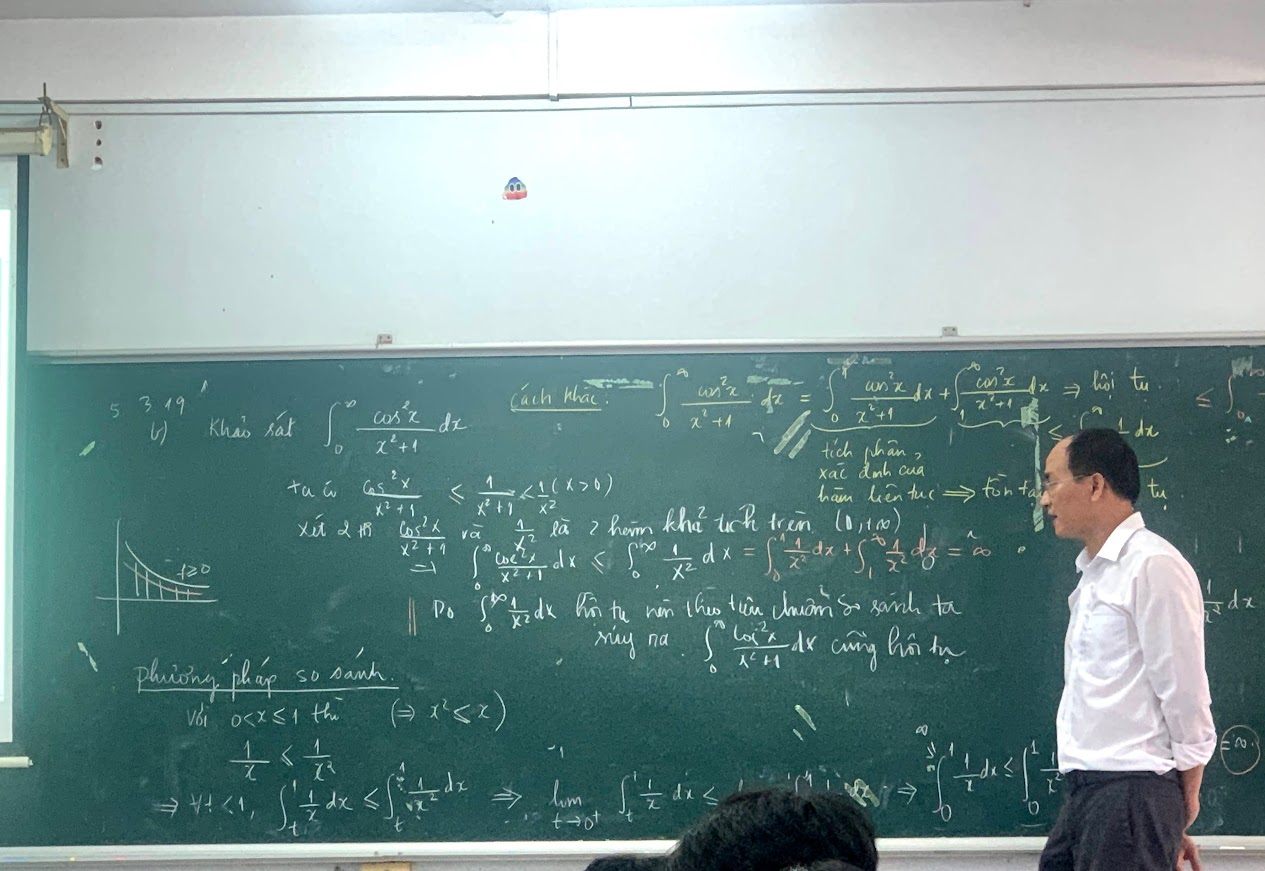
Calculus 1B–2B: You’ll study the pure essence of math—what is a limit, what is a derivative, why is it so. New but old. The 2B knowledge is quite strange and surprising at first, such as functions of two variables, limits of two variables, extrema of two variables, double integrals… requiring you to grasp the knowledge in class and do homework regularly to understand better.
Linear Algebra: The knowledge in this subject is also quite new and headache-inducing at first. You’ll get familiar with matrices, matrix operations, determinants; going deeper you’ll encounter vector spaces, linear maps. Because this course requires understanding and firmly grasping the issue, rote memorization of methods is quite hard for getting a high score.
Math is extremely important for those aiming for AI or Data Scientist, so pay close attention!
For those oriented toward Data Engineer (mainly using technology) or Data Analyst, you may not need to be too good at math.
5. Course List
Year 1
-
Semester 1
| Course | Credits |
|---|---|
| Introduction to Programming | 4 |
| Calculus 1B | 3 |
| Calculus 1B Lab | 1 |
| Marxist-Leninist Political Economy | 2 |
| Marxist-Leninist Philosophy | 2 |
| General Law | 3 |
| English 1 or 2 | 2 |
| Physical Education 1 | 2 |
-
Semester 2
| Course | Credits |
|---|---|
| Introduction to Information Technology | 4 |
| Programming Techniques | 4 |
| Calculus 2B | 3 |
| Calculus 2B Lab | 1 |
| Linear Algebra | 3 |
| Linear Algebra Lab | 1 |
| Elective 1 (TC1) | 2 |
| Elective 2 (TC2) | 2 |
| English 2 or 3 | 2 |
| Physical Education 2 | 2 |
Electives: choose 1 out of 3.
TC1 : General Economics, Teamwork, General Psychology.
TC2: General Environment, Environment & Human, Earth Science.
Year 2
-
Semester 1
| Course | Credits |
|---|---|
| Data Structures & Algorithms | 4 |
| Discrete Mathematics | 3 |
| Discrete Mathematics Lab | 1 |
| Probability & Statistics | 3 |
| Probability & Statistics Lab | 1 |
| Scientific Socialism | 2 |
| History of the Communist Party of Vietnam | 2 |
| Ho Chi Minh Thought | 2 |
| Fundamental Informatics | 3 |
| Elective 1 (TC) | 2 |
| Elective 2 (TC) | 2 |
| English 3 or 4 | 2 |
Electives: choose 2 out of 6.
TC : Physics 1, Physics 2, Biology 1, Biology 2, Chemistry 1, Chemistry 2.
-
Semester 2
| Course | Credits |
|---|---|
| Object-Oriented Programming | 4 |
| Databases | 4 |
| Introduction to Data Science | 4 |
| Statistical Theory | 3 |
Year 3
-
Semester 1
| Course | Credits |
|---|---|
| Introduction to Artificial Intelligence | 4 |
| Computer Networks | 4 |
| Python for Data Science | 4 |
| Computational Software Lab | 2 |
| Combinatorial Mathematics | 4 |
-
Semester 2
| Course | Credits |
|---|---|
| Introduction to Machine Learning | 4 |
| Data Mining | |
| Database Management Systems | 4 |
| Multivariate Statistics | 3 |
| Mathematical Finance Models | 4 |
| Linear Programming | 4 |
| Deep Learning for DS | 4 |
| Social Network Analysis | 4 |
| Financial Computing | 4 |
| Data Visualization | 4 |
| Introduction to Big Data | 4 |
| Advanced Artificial Intelligence | 4 |
| … |
6. How to Choose a Laptop
From the very first year we already study programming and write reports frequently, so investing in a good computer / laptop is truly necessary.
Comments (0)